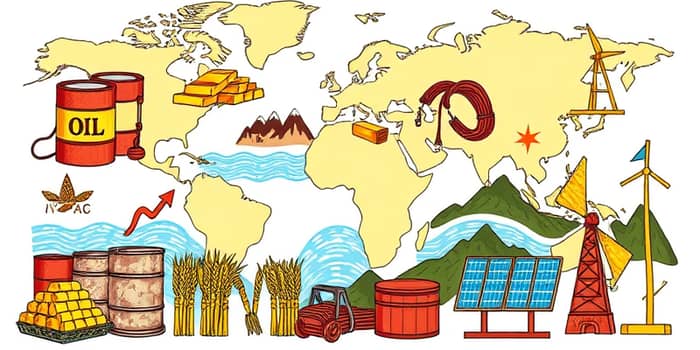
In 2025, raw materials markets stand at a critical juncture, offering both risks and transformative potential for savvy investors.
Global Commodity Market Overview: 2025 Outlook
The commodity landscape is shifting dramatically after a tumultuous period marked by a 14% decline in 2023 and modest 2% growth in 2024. For 2025, analysts at Brainworks Inc. forecast an aggregate Commodity Price Index drop of 1%, while the World Bank anticipates a sharper 12% year-on-year fall, bringing prices to a six-year low.
Amid this backdrop, markets are witnessing the highest level of price volatility in half century. Frequent swings from 2020 to 2024 have heightened uncertainty, with downside risks including weaker global growth, a strong US dollar, and persistent geopolitical instability.
Energy Sector Insights
The energy complex remains the most scrutinized, with divergent trends across oil, gas, coal, and renewables. Following sustained demand weakness, Brent crude is forecast to average $74/bbl in 2025 (EIA) and close the year below $70/bbl (Brainworks Inc.), amid rising OPEC+ output and robust non-OPEC supply.
In contrast, the natural gas sector is poised for a “boom year” driven by burgeoning LNG export capacity, coal-to-gas switching in power generation, and strong consumption in the Americas and Middle East (Oxford Economics; J.P. Morgan). Investors should note the renewed interest in off-balance sheet inventory solutions and prepayment structures fueling growth.
- Oil: Forecast at $74/bbl in 2025, potential further decline to $66/bbl in 2026.
- Natural Gas: Expansion in export capacity, especially in the US, Asia, and Middle East.
- Coal: Slight rebound in consumption for emerging economies, though market share shrinks.
Meanwhile, renewable energy gains momentum. Solar capacity has surged by over 160% in five years, supported by domestic supply chains in China, EU energy security measures, and US cost competitiveness (BNP Paribas). EU Emissions Allowances are expected to reach €95/ton by year-end 2025, underpinned by tightening ETS balances and speculative flows (Citi).
Metals & Mining Trends
The metals complex faces its own headwinds. World Bank forecasts a 10% decline in metals and minerals prices in 2025, followed by a further 3% drop in 2026. Steel remains under pressure from overcapacity, particularly as China ramps up exports to neighboring markets (Oxford Economics).
At the same time, critical base metals such as copper and aluminum could enter a bull market in 2026, driven by dovish Fed policy and lower real interest rates in the US (Citi). Growing demand for lithium and nickel in battery production also underlines the long-term structural story for electric vehicles and grid storage.
Precious metals stand out: gold and silver are projected to surpass record highs in 2025, as central bank purchases accelerate (Oxford Economics; Brainworks Inc.). Investors seeking a hedge against volatility should consider increasing allocations to precious metals before the broader metals cycle turns.
Agricultural Outlook: Soft Commodities
Agricultural markets enter 2025 with ample supplies, leading to modest price pressures. The World Bank anticipates a 2% decline in the agricultural price index, driven by abundant wheat, maize, and soy stocks.
- Wheat: Stocks-to-use ratios remain comfortable, keeping prices elevated but below 2021–2023 peaks.
- Soybeans & Maize: High inventory levels, particularly after strong Brazilian harvests, are likely to keep prices subdued.
- Rice: Easing Indian export restrictions should push prices lower throughout 2025 (Oxford Economics).
Beverage crops like coffee and cocoa may see relief as supplies recover, while cocoa price spikes—driven by adverse yields—highlight opportunities in producer working capital solutions (J.P. Morgan). Biofuel demand is also creating cross-market linkages, bringing energy and soft commodity players closer together.
Key Drivers & Market Dynamics
Several overarching forces will shape commodity performance in 2025:
- Geopolitical instability and shifting trade policies exert continuous pressure on prices and supply chains.
- Climate-related disruptions escalate volatility, as extreme weather events threaten crop yields and production (J.P. Morgan; World Bank).
- Digital enhancements for traditional instruments like L/Cs and BOEs are modernizing trade finance and reducing friction.
- Liquidity solutions such as prepayments and contract monetization are in high demand to support capital-intensive operations.
Understanding these dynamics is critical for positioning portfolios to ride sectoral upswings while hedging downside exposures.
Regional Highlights
Regional dynamics offer differentiated opportunities:
- Americas & Middle East: Natural gas frontrunners with rising LNG capacity and coal-to-gas switching boosting utilities (J.P. Morgan).
- Asia & Middle East: New export capacity supports gas and metals flows amid softer domestic demand.
- Latin America, Africa, Asia: Prepayments and equity investments in critical metal producers are gaining traction.
Expert Commentary & Strategic Insights
Leading financial institutions underscore the importance of agility and innovation:
J.P. Morgan highlights the convergence of energy, metals, and softs markets and the need for new markets for commodity flows in data centers to drive future growth. Oxford Economics notes the dual impact of rising supplies and central bank gold demand on 2025 prices. The World Bank cautions that sustained global growth weakness could intensify price declines, while Citi anticipates a precious metals bull run broadening into base metals by 2026.
BNP Paribas points to the transformative power of Power Purchase Agreements in stabilizing renewable investments, and Deutsche Bank forecasts continued oil price declines as non-OECD consumption rises, especially in India.
Key Numbers & Price Forecasts (2025)
Investment Strategies & Practical Takeaways
To navigate this complex environment, investors should consider a blend of strategic approaches:
- Diversify across sectors and regions to mitigate idiosyncratic risks and capture emerging growth pockets.
- Leverage working capital solutions such as prepayments and inventory financing to secure supply chain advantages.
- Allocate to precious metals as a hedge against uncertainty, while underweighting overcapacity sectors like steel.
- Monitor monetary policy shifts for timing entry into base metals, which may lead a broader commodity resurgence in 2026.
- Incorporate renewable-related instruments, including carbon allowances and PPA-backed assets, to align portfolios with energy transition trends.
Conclusion
2025 presents a pivotal year for commodity investors. While broad price declines and volatility pose challenges, targeted allocations—backed by rigorous analysis of sector-specific drivers, regional dynamics, and expert insights—can uncover compelling opportunities. By combining traditional hedges with innovative financing tools and a forward-looking stance on renewable and critical metals, investors can position themselves to thrive in the evolving landscape of raw material markets.
References
- https://www.jpmorgan.com/insights/treasury/forecasting-planning/commodities-market-trends
- https://www.oxfordeconomics.com/resource/five-key-commodity-trends-to-watch-for-in-2025/
- https://brainworksinc.com/commodities-market-experienced-traders-2025/
- https://globalmarkets.cib.bnpparibas/commodity-markets-energy-markets-2025/
- https://www.citigroup.com/global/insights/commodities-market-outlook-4q-25
- https://flow.db.com/trade-finance/commodities-outlook-for-2025-prices
- https://www.morganstanley.com/im/en-sg/institutional-investor/insights/articles/commodity-outlook-2025-three-areas-to-watch.html
- https://www.spglobal.com/commodity-insights/en/news-research/topics/commodities-2025
- https://tradingeconomics.com/forecast/commodity
- https://www.bloomberg.com/markets/commodities