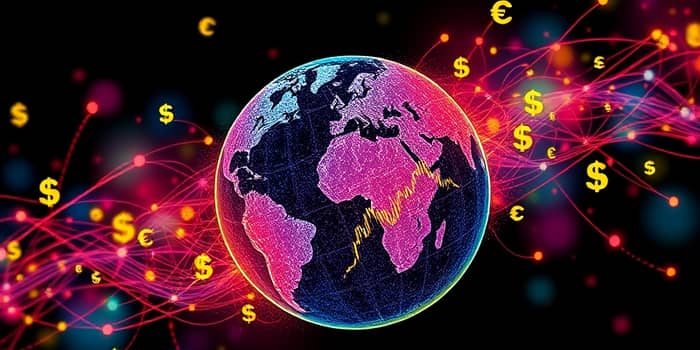
Imagine a world where money moves faster than light, connecting continents and cultures through the simple act of exchange.
This is the foreign exchange market, or forex, the largest financial market on Earth, where over $7 trillion changes hands daily.
It operates 24 hours a day, five days a week, fueling global trade, travel, and investment with unparalleled accessibility.
From a tourist exchanging pounds for euros to a corporation hedging against currency risk, forex touches every corner of our interconnected economy.
In this article, we'll dive deep into this dynamic arena, unraveling its mechanics and empowering you with practical knowledge to navigate it confidently.
What is the Forex Market?
The forex market is a decentralized, over-the-counter network where currencies are bought and sold, enabling everything from international business to speculative trading.
Unlike stock markets with central exchanges, forex thrives on a vast, interconnected web of participants, including banks, businesses, and individual traders.
This structure allows for immense liquidity and flexibility, making it possible to trade at any time during the week.
For retail traders, participation often involves using dealers to speculate on currency movements without the need for physical delivery.
- Businesses use forex for international transactions and hedging risks.
- Individuals trade for profit through currency fluctuations.
- Speculators aim to capitalize on short-term price changes.
Understanding this foundation is key to grasping how forex can be both a tool for stability and an opportunity for growth.
How Forex Trading Works: Currency Pairs and Pricing
At the heart of forex trading are currency pairs, which always involve two currencies: a base and a quote.
The base currency is the one being bought or sold, while the quote shows how much of it is needed to purchase one unit of the base.
For example, in EUR/USD, the euro is the base, and the U.S. dollar is the quote, indicating how many dollars one euro can buy.
When you buy a pair, you expect the base currency to strengthen against the quote, leading to potential profits.
Conversely, selling a pair means anticipating the base will weaken, allowing you to buy it back at a lower price later.
Prices are quoted with precision, such as EUR/USD at 1.3553, meaning one euro buys 1.3553 U.S. dollars.
Profit arises when the pair's value increases, indicating the base currency has strengthened relative to the quote.
Trades are often executed in standard lots of 100,000 units, which amplifies small price movements into significant gains or losses.
This standardization helps manage exposure and risk in a market where fluctuations can be minute yet impactful.
- Major pairs include EUR/USD, GBP/USD, and USD/JPY.
- Exotic pairs involve less common currencies with higher spreads.
- Cross pairs exclude the U.S. dollar, like EUR/GBP.
Types of Forex Markets
Forex trading occurs across different markets, each serving unique purposes and timeframes.
The spot market is where currencies are exchanged immediately at the current market price, ideal for quick transactions.
In the forward market, agreements are made to exchange currencies at a future date at a fixed rate, commonly used for hedging.
The futures market involves standardized contracts traded on exchanges, offering transparency and regulation for major currencies.
Other forms include options and contracts for difference (CFDs), which allow traders to speculate on price movements without owning the underlying asset.
- Spot forex is the most liquid and accessible for retail traders.
- Forward contracts help businesses lock in rates to avoid volatility.
- Futures provide a regulated environment with set expiration dates.
Choosing the right market depends on your goals, whether it's short-term speculation or long-term risk management.
Factors Influencing Exchange Rates
Exchange rates are in constant flux, driven by a complex interplay of economic, political, and psychological factors.
Economic indicators like GDP growth, employment data, and inflation reports can sway currency values significantly.
Interest rate differentials are a primary driver, as higher rates attract foreign capital, strengthening a currency.
Central bank actions, such as quantitative easing, increase money supply and can weaken a currency over time.
Political stability and geopolitical events also play crucial roles, influencing investor confidence and market sentiment.
Market sentiment, shaped by news and trader perceptions, often leads to short-term volatility and rapid price changes.
- Key drivers include economic data releases and central bank announcements.
- Geopolitical risks can cause sudden shifts in currency strength.
- Trader psychology and risk appetite affect daily trading volumes.
Understanding these influences helps traders anticipate movements and make informed decisions in a dynamic environment.
Key Trading Concepts and Execution
Successful forex trading hinges on mastering core concepts like leverage, position sizing, and risk management.
Leverage allows traders to control large positions with a small amount of capital, such as 100:1 leverage on a $1,000 margin.
This amplifies both profits and losses, making it essential to use with caution and proper risk controls.
Position sizing involves determining how much to trade based on risk tolerance, often using lot sizes to standardize exposure.
Risk management strategies, including stop-loss orders and profit targets, protect against unexpected market swings.
To open a trade, follow these steps to ensure a structured and disciplined approach.
- Select a currency pair based on analysis and market conditions.
- Determine the trade size and acceptable risk level.
- Choose a direction: buy if expecting a rise, sell if expecting a fall.
- Set an entry point using market or limit orders.
- Add stop-loss and profit target orders to manage risk.
- Review and submit the trade, monitoring it closely.
Costs in forex are primarily the spread, with no commissions in many cases, making it a cost-effective market for active traders.
Trading venues for retail participants include over-the-counter dealers and futures exchanges, each with its own regulations and benefits.
Practical Examples and Beginner Tips
Let's explore a practical scenario to illustrate how forex trading works in real life.
Suppose you buy EUR/USD at 1.3553, expecting the euro to strengthen against the U.S. dollar.
If the pair rises to 1.3600, you can sell it for a profit, as the base currency has appreciated relative to the quote.
Conversely, if it falls, a stop-loss order can limit your loss, demonstrating the importance of risk management.
For beginners, starting with major pairs like EUR/USD or GBP/USD is advisable due to their liquidity and lower spreads.
Develop a trading strategy that incorporates both technical analysis, such as chart patterns, and fundamental analysis, like economic news.
- Practice with a demo account to build confidence without financial risk.
- Stay informed about global events that could impact currency markets.
- Use leverage sparingly and always have a risk management plan in place.
- Focus on continuous learning and adapting to market changes.
- Consider long-term trends and avoid impulsive decisions based on short-term volatility.
Remember, forex trading is not a get-rich-quick scheme but a skill that requires patience, discipline, and ongoing education.
Embracing the Forex Journey
Forex trading offers a gateway to the global economy, providing opportunities for growth, learning, and financial independence.
By understanding the mechanics, influences, and strategies, you can navigate this vast market with greater confidence and clarity.
Whether you're hedging business risks or speculating for profit, the key lies in a balanced approach that prioritizes knowledge over impulse.
As you embark on this journey, let curiosity guide you, and let prudence protect you, for in the dance of currencies, wisdom is the ultimate currency.
References
- https://holbornassets.com/blog/a-beginners-guide-to-foreign-exchange-markets/
- https://tastytrade.com/learn/trading-products/forex/how-to-trade-forex/
- https://www.ig.com/en/forex/what-is-forex-and-how-does-it-work
- https://forex.tradingcharts.com/learn_forex/3._Forex_Trading_Basics.html
- https://monexusa.com/insight/fx-trading-for-dummies-beginners-guide-to-foreign-exchange/
- https://www.youtube.com/watch?v=PBQXRx-E4LE
- https://www.schwab.com/learn/story/foreign-exchange-forex-trading-beginners
- https://www.babypips.com/learn/forex/what-is-forex