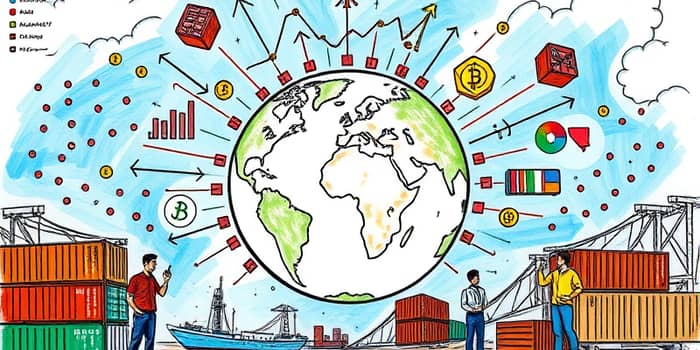
In an era defined by interwoven financial, political and technological forces, investors face unprecedented challenges and opportunities. This article unpacks global forecasts, regional divergences, inflation trends, geopolitical risks and technological disruptions. By understanding these factors with insights from leading institutions, readers can craft robust, adaptive strategies that thrive amid uncertainty.
Global Growth Forecasts in 2026
Major organizations project world GDP growth between 2.6% and 3.3% in 2026, well below pre-pandemic averages around 3.2%. These contrasts reflect varied assumptions on policy, trade and technology adoption. While the IMF sees stronger resilience via AI investment, UN bodies and UNCTAD highlight headwinds from tariffs and debt burdens.
UN DESA forecasts 2.7% growth, pointing to record-high public debt levels in many developing countries that limit fiscal space. UNCTAD’s 2.6% reflects slowing major economies and weakening demand. The ACCA outlook above 3% balances optimism around AI with fragility from geopolitical tensions.
Projections incorporate ongoing fiscal and monetary support, but risk models flag downside scenarios: sudden tariff escalations, policy missteps or unforeseen climate events could shave tens of basis points off global growth. Investors should remain nimble, monitoring leading indicators such as purchasing managers’ indexes and trade volumes for early signals of momentum shifts.
Although forecast methodologies differ, the consensus underscores a cautious global outlook with upside potential from innovation and policy support. Real-time data will determine whether actual growth aligns with these scenarios or diverges markedly.
Regional Divergences and Opportunities
Growth patterns vary sharply across regions, generating distinct investment cases. Advanced economies grapple with moderating expansion, while select emerging markets offer higher returns albeit with greater volatility. South-South trade is gaining traction, reshaping global export routes.
- United States: 1.5%–2.4%, driven by fiscal stimulus, consumer resilience and AI-led productivity gains.
- European Union: ~1.3%, impacted by trade barriers, energy costs and demographic headwinds.
- China: 2.5%–4.6%, supported by industrial policies but challenged by property sector strains.
- India: ~6.6%, emerging as a key growth engine through infrastructure spending and digital adoption.
- Africa & Middle East: 3.9%–4.6%, with growth bolstered by commodity exports but hampered by debt service and climate risks.
Emerging Asia’s combined growth around 4.4% contrasts with advanced economies’ near 1.5%. Within Africa, South-South partnerships account for over half of exports, reducing reliance on traditional European and American markets. This trend opens avenues in sectors like agriculture, manufacturing and green energy.
Investors may consider dedicated emerging market equity funds or local bond markets to capture regional upside, while hedging currency risk through derivatives or multi-currency portfolios.
Inflation Trends and Monetary Policy
After peaking above 4%, global headline inflation is on track to decline to 3.1% in 2026. However, core inflation remains sticky in many economies, driven by labor market tightness and logistical bottlenecks. Energy and food prices continue to exhibit volatility, influenced by climate events and geopolitical supply constraints.
Central banks face a delicate balance between sustaining growth and preventing inflationary spirals. Some have signaled rate cuts as early as mid-2026, while others maintain caution. Investors should monitor wage growth data, commodity price indices and central bank minutes for clues on policy pivot timing signals.
Real yields and break-even inflation rates offer guidance on bond allocations. Rising break-even rates may justify inflation-protected securities, while a sudden disinflation environment could favor long-duration government bonds.
Geopolitical Risks and Trade Fragmentation
The interplay of power politics and commerce is increasingly shaping market dynamics. The Ukraine conflict persists as a drag on regional economies and global grain supplies, while US-China tensions have led to selective decoupling in critical industries like semiconductors and rare minerals.
- Ukraine war: Lower growth in CIS countries and persistent energy volatility in Europe.
- US tariffs: Renewed measures on semiconductors and critical minerals, pressuring tech supply chains.
- Trade blocs: ASEAN and African Continental Free Trade Area initiatives boost South-South linkages.
These developments may undermine global supply chains in the short term but also spur diversification and localization trends. Companies and investors that anticipate shifts can secure first-mover advantages in regional manufacturing hubs and alternative shipping routes.
AI, Tech Boom, and Bubble Risks
Artificial intelligence is at the forefront of the investment narrative, with massive capital flows into software, chip manufacturers and cloud platforms. While productivity breakthroughs promise transformative gains, soaring valuations raise concerns about an overheating market.
The rapid rise in Chinese tech equities, sometimes outpacing their US counterparts, illustrates both opportunity and risk. Regulatory developments, intellectual property disputes and ethical debates around AI deployment could trigger sudden repricings. Diligent analysis of cash flow generation and competitive moats is essential to separate sustainable leaders from speculative names.
Investment Implications and Strategies
Investors should adopt a multifaceted approach to navigate this complex backdrop. Strategic themes, such as digital transformation and climate resilience, intersect with cyclical factors like interest rates and commodity cycles.
- Diversification across asset classes and regions to mitigate growth differentials and policy risk.
- Thematic allocations to AI, renewable energy and healthcare innovation for structural tailwinds.
- Use of inflation-linked bonds, commodities or real assets to hedge against persistent price pressures and volatility.
- Maintaining liquidity reserves to capitalize on dislocations arising from policy shifts or geopolitical shocks.
Integrating environmental, social and governance criteria can further enhance portfolio resilience, as sustainable business models often demonstrate stronger risk management and long-term profitability.
Building Resilience in Portfolios
Stress-testing against scenarios—accelerated inflation, abrupt monetary tightening, major geopolitical events—helps identify vulnerabilities within allocations. Investors can then adjust position sizes, add protective overlays or rotate into defensive sectors like utilities and consumer staples.
Embracing long-term structural technology megatrends while managing short-term noise requires a disciplined investment process. Regular portfolio reviews, informed by quantitative models and qualitative insights, are crucial to staying ahead of evolving market conditions.
Conclusion: Navigating an Uncertain Landscape
Global dynamics in 2026 are characterized by moderated growth, evolving trade patterns and transformative technological advances. By synthesizing authoritative forecasts and adopting adaptive investment frameworks and processes, investors can turn uncertainty into opportunity. Vigilance, flexibility and strategic foresight will be the hallmarks of success in a world defined by rapid change and interconnection.
References
- https://desapublications.un.org/publications/world-economic-situation-and-prospects-2026
- https://unctad.org/news/10-trends-shaping-global-trade-2026
- https://www.accaglobal.com/gb/en/professional-insights/global-economics/global-economic-outlook-2026.html
- https://www.imf.org/en/publications/weo/issues/2026/01/19/world-economic-outlook-update-january-2026
- https://www.atlanticcouncil.org/dispatches/five-trends-to-watch-in-the-global-economy-in-2026/
- https://www.pictet.com/ch/it/insights/global-economic-outlook-2026
- https://www.weforum.org/meetings/world-economic-forum-annual-meeting-2026/sessions/global-economic-outlook-af4fed3639/
- https://www.worldbank.org/en/publication/global-economic-prospects
- https://www.oxfordeconomics.com