In an era defined by volatility and disruption, risk management has transcended its traditional role to become a cornerstone of strategic success.
By 2026, the landscape demands a seismic shift from reactive firefighting to proactive, technology-driven strategies that empower organizations to not only survive but thrive.
This evolution integrates artificial intelligence, predictive analytics, and real-time monitoring to transform uncertainty into opportunity.
Imagine a world where threats are anticipated before they materialize, allowing businesses to pivot with confidence and resilience.
The journey begins with embracing holistic frameworks that view risk as an interconnected web rather than isolated events.
The Evolution of Risk Management
Gone are the days of static risk registers and simplistic probability-impact matrices that offered limited foresight.
Today, advanced techniques prioritize dynamic approaches with continuous monitoring and scenario planning.
Key changes driving this transformation include:
- Moving from periodic assessments to real-time data analysis.
- Integrating risk management with enterprise-wide systems for a unified view.
- Adopting agile and hybrid environments to embed risk practices in daily operations.
- Shifting focus to nonlinear modeling for cascading threats.
- Leveraging human-AI synergy to augment judgment and scalability.
This proactive stance enables organizations to build structural immunity against unforeseen challenges.
Modern Risk Management Frameworks
Contemporary frameworks are designed to be adaptive and data-rich, pulling insights from diverse sources like project management systems and market indicators.
They emphasize early warning systems and predictive algorithms to detect patterns invisible to human analysis.
Essential components include:
- Proactive identification through environmental scanning and automated alerts.
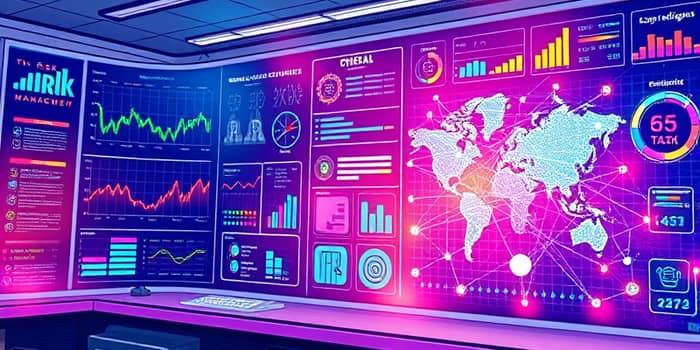
- Real-time monitoring via dashboards that visualize risk exposure.
- Enterprise integration to aggregate project-level risks into portfolio views.
- Agile adaptation with risk practices embedded in sprints and retrospectives.
By embedding risk into schedules and budgets, organizations can achieve more accurate forecasting and resource allocation.
Advanced Risk Identification Techniques
Moving beyond brainstorming and historical data, technology-enhanced methods offer comprehensive coverage of emerging threats.
Machine learning algorithms can analyze vast datasets to spot overlooked patterns from thousands of past experiences.
Collaborative platforms facilitate techniques like the Delphi method and SWOT analysis across dispersed teams.
Key techniques to implement:
- AI-driven analysis of unstructured data from news and social media.
- Environmental scanning for regulatory changes and market trends.
- Automated alerts for competitor actions and technological developments.
- Use of predictive analytics to forecast issues from historical patterns.
These approaches ensure that real-time sensing and foresight become integral to risk identification.
Quantitative and Qualitative Analysis Tools
Sophisticated tools blend quantitative precision with qualitative depth to assess risks comprehensively.
Monte Carlo simulations run thousands of scenarios to provide probability distributions for outcomes like schedule and budget ranges.
Predictive analytics forecast deviations in compliance and supplier performance, enhancing accuracy over project cycles.
Tools to leverage include:
- Qualitative assessments with inherent and residual risk scoring.
- Scenario analysis to model hypothetical events and chain reactions.
- Stress-testing assumptions through red teaming exercises.
- Integrated software for seamless risk flow and anomaly detection.
This blend enables organizations to anticipate and mitigate negative outcomes before they escalate.
Emerging Technologies and Tools
In 2026, AI, machine learning, and data analytics dominate the risk management toolkit, shifting from experimental to mainstream applications.
These technologies enhance prediction, automation, and real-time response capabilities.
Other tools include integrated project management software for seamless risk flow and continuous sensing systems.
Risk Response Planning and Mitigation Strategies
Effective strategies combine traditional methods with dynamic, integrated approaches to address complex threats.
Contingency frameworks and decision trees provide multi-scenario responses with trigger criteria for adaptive actions.
Key strategies include:
- Integrated responses that address multiple risks through single actions.
- Rapid response plans for cyber incidents to minimize downtime.
- Phased implementation to build on existing practices sustainably.
- Preventative measures based on forecasts to reduce negative outcomes.
This ensures that organizational resilience and adaptability are prioritized in risk mitigation.
Risk Monitoring, Control, and Measurement
Replacing static registers with automated, real-time systems is crucial for effective risk management.
Dashboards track key indicators and response effectiveness, providing continuous visibility into new risks.
Major components to focus on include identification, assessment, treatment, and monitoring.
By embedding analytics business-wide, organizations can respond agilely to shifting environments like geopolitical or climate events.
This proactive monitoring fosters a culture of continuous learning and improvement.
Key Risks and Compliance Concerns for 2026
As threats evolve, top risks include cybersecurity, supply chain disruptions, AI behaviors, and geopolitical instability.
Nonlinear effects, such as exponential cross-systemic impacts, require sophisticated modeling to manage cascading failures.
Global compliance concerns encompass AI governance, crypto regulations, ESG standards, and data privacy laws.
To prepare, organizations must develop resilient strategies that integrate compliance into risk frameworks.
This approach helps navigate the complex interconnected risk landscape of the future.
Practical Implementation and Future Outlook
Implementing advanced risk management requires a phased approach with organizational support and continuous learning.
Strategies include investing in analytics, automating assessments, and designing scenarios for nonlinear risks.
Success factors involve certifications like PMP for frameworks and fostering human-AI collaboration.
The future outlook emphasizes risk as a strategic capability, with AI augmenting human judgment amid tech acceleration.
By embracing these techniques, businesses can transform uncertainty into a competitive advantage, ensuring longevity in an unpredictable world.
References
- https://www.exam-labs.com/blog/advanced-risk-management-tools-and-techniques-for-modern-projects-in-2026
- https://www.simplilearn.com/risk-management-tools-article
- https://www.trustcloud.ai/risk-management/unlock-resilient-risk-management-strategies-for-yy-success/
- https://www.solvexia.com/blog/risk-mitigation-tools
- https://www.sedgwick.com/blog/preparing-your-risk-management-program-for-2026-and-beyond/
- https://www.cyberarrow.io/blog/top-10-risk-management-strategies/
- https://www.metricstream.com/blog/top-operational-risk-management-orm-tools.html
- https://www.thomsonreuters.com/en/reports/10-global-compliance-concerns-for-2026
- https://secureframe.com/blog/risk-management-statistics