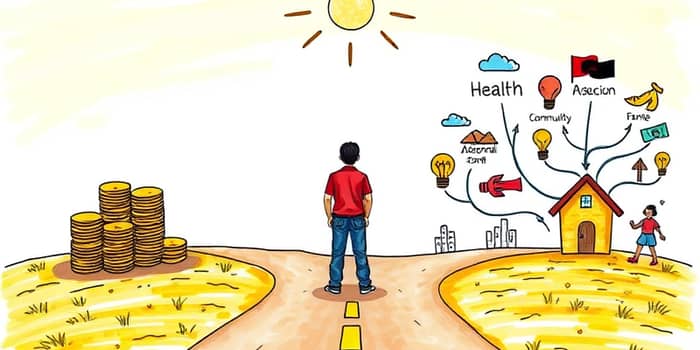
In a world obsessed with financial success, we often measure prosperity by bank balances and material possessions.
Yet, this narrow focus leaves out the non-monetary dimensions of a fulfilling life that truly enrich our existence.
True wealth encompasses health, relationships, personal capabilities, and deep satisfaction beyond what money can buy.
This article explores how to redefine riches for a more holistic and inspiring approach to living well.
The Shortcomings of Material Metrics
Traditional measures like income and net worth fall short in capturing real prosperity.
They assume advantage lies solely in budgets for goods and services, ignoring vital non-market factors.
For instance, wealth gaps often exceed income disparities across racial and ethnic groups, highlighting deeper issues.
This limitation means life's complex aspects, such as health and social connections, remain overlooked.
- Income is incomplete: It correlates with health but fails to account for lifetime resources, especially post-retirement.
- Wealth requires detailed data: Net worth involves complex calculations with multiple asset and debt classes, making it cumbersome.
- Simpler proxies like homeownership are useful but oversimplify the relationship between health and wealth.
Wealth can buffer low income during crises like illness, yet it still misses the full picture of human flourishing.
Theoretical Pathways to Holistic Wealth
Scholars propose alternative frameworks to address these gaps.
The equivalent income approach adjusts monetary income for non-market factors like environment and personal preferences.
It asks what income would maintain your satisfaction if other life aspects were standardized.
- Extended equivalent income includes health and social aspects, offering a more personalized measure.
- This method is superior for reflecting individual priorities and intertemporal aspects of permanent income.
Amartya Sen's Capability Approach generalizes budget sets to capability sets, focusing on what people can actually achieve.
It emphasizes choosable functionings such as nutrition and education, independent of monetary institutions.
This framework is promising for its comprehensiveness and sensitivity to overlapping advantages in diverse societies.
Practical Dimensions of Non-Material Wealth
Financial advisors and experts highlight tangible non-monetary dimensions that contribute to true riches.
These elements provide a roadmap for integrating holistic measures into daily life.
- Health: Often cited as the most valuable possession, it directly impacts time and quality of life.
- Relationships and Family: Spending meaningful time with loved ones builds emotional wealth.
- Community and Service: Giving back enhances personal fulfillment and combats overspending traps.
- Adventure and Experiences: Intentional spending on activities, as discussed in TED Talks on happiness, boosts joy.
- Personal Fulfillment: Aligning goals with independence and purpose drives long-term satisfaction.
Advisors help by focusing on underspending and generosity over mere accumulation.
This shift fosters a healthier money view that supports overall well-being.
These dimensions encourage a balanced life where material and non-material aspects coexist harmoniously.
Empirical Insights: Data on Assets and Debts
Surveys like the Survey of Consumer Finances (SCF) and Health and Retirement Study (HRS) provide data on wealth proxies.
These simplify net worth while still correlating with health outcomes.
- Dollar-based proxies include assets only or debts only, with prevalent items like checking accounts.
- Ownership-based indices assign scores for assets and debts, making measurement more accessible.
Key data from 2004 U.S. surveys show medians and prevalences for common financial items.
This table highlights how primary residence often dominates net worth, especially in older populations.
Net worth tends to be higher in older groups due to lower debt and higher homeownership.
These proxies yield similar results in health models, suggesting simplified measures can be effective for research.
Challenges in Measuring True Wealth
Adopting holistic measures comes with difficulties, such as gathering preference-based data.
Individual priorities vary widely, making interpersonal comparisons complex.
- Data collection requires detailed surveys on non-market factors, which can be resource-intensive.
- Fairness in comparisons must account for cultural and societal differences in defining prosperity.
Despite these challenges, the move towards comprehensive criteria is gaining traction.
Tools like eMoney help in goal-based planning, redefining wealth towards independence and fulfillment.
This approach reduces racial disparities by focusing on broader life dimensions beyond money.
Embracing a Fuller Definition of Wealth
Redefining riches invites us to look beyond material accumulation.
It encourages a life rich in experiences, connections, and personal growth.
- Start by assessing your non-monetary assets, such as health and relationships.
- Set goals that align with holistic dimensions, like community service or adventure.
- Use financial planning tools to integrate these aspects into your long-term strategy.
By doing so, we can build a prosperity that is resilient and deeply satisfying.
This holistic view not only enhances individual well-being but also fosters a more equitable society.
Let this be a call to action to measure success by the richness of your entire life, not just your wallet.
References
- https://pmc.ncbi.nlm.nih.gov/articles/PMC3076388/
- https://smithpartnerswealth.com/5-measures-of-wealth/
- https://www.smithmosesandcozad.com/blog/here-are-eight-ways-to-measure-wealth-only-one-is-money
- https://www.wealthmanagement.com/high-net-worth/beyond-money-4-ways-advisors-help-clients-achieve-personal-wealth
- https://emoneyadvisor.com/blog/helping-clients-redefine-wealth/