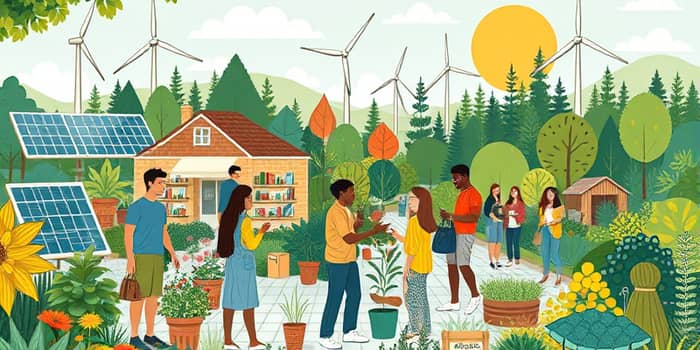
Your spending power shapes the world around you in profound ways. Every purchase and investment sends a signal about the kind of future you want to help create. By choosing where and how to allocate your resources, you can drive innovation, empower communities, and protect the ecosystems on which all life depends.
This article explores how you can align your personal finances with environmental and social goals, drawing on the latest 2026 forecasts for sustainable finance, consumer behavior trends, and practical strategies to close critical funding gaps.
Understanding Sustainable Spending
Sustainable spending aligns personal choices with environmental impact. Consumers are awakening to the power of mindful consumption and investment as a lever for change, recognizing that ordinary transactions can underwrite clean technologies, equitable labor practices, and nature-positive projects.
Picture a world where your morning coffee, commute, and online purchases are part of a collective movement toward regeneration. By deliberately selecting eco-friendly products and services, you reduce waste, lower carbon footprints, and signal to corporations that sustainability must be at the heart of their strategies.
Consumer Behavior and Market Influence
Recent surveys show that 72% of consumers are willing to pay a premium for sustainable products, with an average markup of 9.7%. Waste-conscious brands capture 34% more loyalty, and ESG products have driven 56% of market growth—18% above the broader consumer sector.
Driving this movement is a sense of shared responsibility, where individuals recognize that their spending patterns can fund clean energy projects, support fair labor practices, and reduce global inequality. Households now contribute to 40% of domestic private climate finance efforts, demonstrating the scale of personal impact.
Sustainable Finance Trends and Forecasts (2026)
Global issuance of sustainable bonds is forecast at $900 billion—steady year-on-year. Within this total, green bonds lead with $530 billion, followed by social bonds ($115 billion), sustainability bonds ($190 billion), transition bonds ($40 billion), and sustainability-linked bonds ($25 billion).
Public budgets and official development assistance are tightening. ODA declines from $213 billion in 2023 to $145 billion by 2026, amplifying the need for private capital to bridge the gap. Private finance to developing countries must surge to $1.3 trillion in external flows by 2035—a 16× jump from $40 billion in 2022.
Regional dynamics further underscore the complexity of the landscape. Asia continues to lead solar capacity additions while North America prioritizes private adaptation investments. Initiatives such as the NZAM Relaunch and SCALED phase 2 are standardizing blended finance approaches to boost capital mobilization.
Bridging the Funding Gaps in Climate Adaptation and Biodiversity
Climate adaptation finance is alarmingly low. Developing countries need $310–$365 billion annually by 2035 but receive only $26 billion today—a gap 12 to 14 times larger. Without urgent action, vulnerable populations face greater risks from extreme weather, food insecurity, and displacement.
Biodiversity conservation also suffers a nearly $1 trillion annual shortfall. Private flows amount to a mere $23 billion, while nature-negative activities cost global economies $4.9 trillion each year. Transitioning to nature-positive operations could unlock $10.1 trillion in value.
Concrete examples illustrate the power of private finance. In coastal regions, bonds issued to support mangrove restoration protect shorelines and sequester carbon, delivering both ecological and financial returns. Blended finance vehicles, public guarantees, and targeted regulations can unlock similar projects at scale.
Practical Strategies for Individuals
- Allocate a portion of savings to green bonds and ESG funds offered by reputable issuers.
- Support companies with robust circular economy initiatives, reducing waste and resource intensity in production.
- Engage in carbon pricing mechanisms or purchase verified carbon credits to offset personal emissions.
- Invest in nature-positive funds that target restoration and conservation, tapping into the underfunded biodiversity sector.
- Advocate for sustainable policies locally and nationally to expand green infrastructure.
Overcoming Challenges and Seizing Opportunities
Political constraints such as defense and AI investment often divert resources from climate priorities. Moreover, rapid growth in data centers could push electricity demand beyond 2,200 TWh by 2030, equaling India’s national consumption.
Yet innovation flourishes in adversity. Advances in battery storage, hybrid renewables, and carbon capture are reducing costs and increasing resilience. AI-driven efficiency gains can optimize resource use, while rigorous ESG reporting standards enhance accountability.
As consumers and investors, you can catalyze these developments by directing capital toward adaptive agriculture, sustainable urban development, and resilient infrastructure. By aligning your financial choices with environmental objectives, you amplify collective impact.
Conclusion: Align Your Wallet with the Planet
Every decision at the checkout counter and within investment portfolios reverberates across communities and ecosystems worldwide. By embracing sustainable spending habits and channeling funds toward green, social, and sustainability-linked instruments, you can help close critical funding gaps, enhance global resilience, and preserve biodiversity.
Your wallet is more than a wallet—it is a catalyst for change. Start today by reviewing your spending, reallocating investments, and championing policies that prioritize planetary health and social equity. In doing so, you become an active architect of a brighter, more sustainable future.
References
- https://www.moodys.com/web/en/us/insights/credit-risk/outlooks/global-sustainable-finance.html
- https://www.wri.org/technical-perspectives/6-opportunities-sustainable-finance-2026
- https://www.spglobal.com/sustainable1/en/insights/2026-sustainability-trends
- https://www.arbor.eco/blog/sustainability-statistics
- https://www.schroders.com/en-us/us/institutional/insights/2026-sustainable-investment-outlook-7-key-trends-for-north-america-in-the-year-ahead/
- https://www.americancentury.com/institutional-investors/investment-outlook/sustainable-investing-trends/
- https://atr.org/budgetproject/
- https://www.lseg.com/en/ftse-russell/research/2026-sustainable-investment-trends
- https://www.cbo.gov/publication/62105
- https://cse-net.org/sustainability-and-economic-growth-how-u-s-companies-can-achieve-both-in-2026/