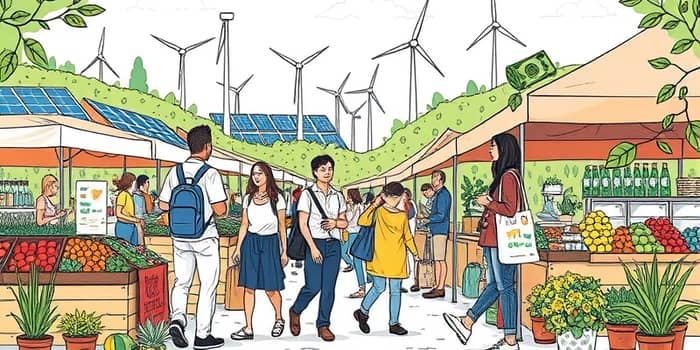
In an era of rising environmental concerns and economic uncertainty, it’s crucial to adopt strategies that safeguard both our finances and the Earth we depend on. Sustainable spending empowers individuals, businesses, and governments to make choices that deliver financial savings and environmental impact in tandem.
The Consumer Power in Sustainable Spending
Today’s consumers wield immense influence. Recent surveys reveal that 72% of global buyers are willing to pay a premium for green products, even when facing cost-of-living pressures. This shift signifies more than a trend—it reflects a growing desire to align daily purchases with long-term planetary health.
Brands with robust recycling and waste-reduction programs capture 34% more loyalty. On average, shoppers pay about 9.7% extra for sustainably produced goods. These premiums aren’t lost costs; they translate into increased brand value and customer trust over time.
- Support for recycled and upcycled materials
- Preference for energy-efficient appliances
- Growing demand for ethically sourced food and fashion
- Willingness to explore sharing and secondhand platforms
Financing the Future: Sustainable Finance and Debt Issuance
Global sustainable finance volumes (excluding asset-backed securities) are on track for US$1,621 billion in 2026, up from US$1,539 billion in 2025. Green bonds remain the backbone of this growth, backed by issuers committed to reduce long-term energy bills and emissions.
Non-financial corporations alone are expected to issue US$640 billion of sustainable debt in 2026—10% higher than the prior year. While the U.S. market shows modest declines, APAC leads with robust investments in renewables and grid upgrades.
Beyond direct issuance, investors can make informed sustainable investment decisions through blended finance, nature-based solutions, and emerging green credit frameworks.
- Scaling private finance to US$1.3 trillion external by 2035
- Standardizing blended finance under SCALED phase 2
- Mobilizing nature-based solutions from US$23 billion annually
Riding the Renewable Wave: Energy Transition Benefits
The renewable energy sector is experiencing record momentum. Solar and wind capacity are projected to grow over 17% in 2026, while fossil fuel demand remains flat. Even with a slight slowdown in solar installations in China, global deployments continue to drive down unit costs and improve storage solutions.
Data centers are among the top clean power buyers, reflecting a broader corporate push for transition to renewable energy sources that both reduce carbon footprints and stabilize electricity expenses.
Complementing direct energy savings, carbon pricing mechanisms now cover 28% of global emissions. Revenues from carbon fees and green credits fund further decarbonization and ecosystem restoration, creating a virtuous cycle of investment and impact.
Policy and Infrastructure: Government’s Role
Public policy and infrastructure investment underpin successful sustainable spending strategies. Official Development Assistance (ODA) for climate and nature projects will total an estimated US$145 billion in 2026, following peak support in recent years.
Innovative facilities like the Tropical Forest Forever Facility aim for US$4 billion per year across 74 countries, though they require upfront capital of US$6.6 billion. Clear frameworks and concessional finance unlock private capital and drive drive positive environmental change at scale.
Take Canada as an example: the nation plans 50,000 zero-emission vehicle chargers by 2027, alongside US$27.6 billion in green infrastructure projects by 2028. Such commitments not only reduce emissions but also stimulate job creation and regional development.
Key Drivers and Challenges
Multiple factors enable momentum in sustainable spending. Corporate decarbonization targets for 2030, expanding AI-driven efficiency tools, and supportive regulation all nurture a fertile environment for green finance.
Yet headwinds remain. Political shifts can mute issuance, while skepticism around sustainability-linked bonds persists when performance penalties are weak. Cuts in ODA and reallocation of defense budgets also strain available climate finance.
- Growth enablers: government funding, regulatory frameworks, corporate climate commitments
- Challenges: credibility gaps in SLBs, geopolitical uncertainties, ODA reductions
To navigate these dynamics, prioritize investments that offer both environmental and financial returns. Green bonds, renewable power purchase agreements, and consumer-premium products strengthen brand loyalty and leverage green bonds for projects that matter.
Ultimately, sustainable spending isn’t a luxury—it’s a necessity. By adopting responsible consumption habits, channeling capital into green finance instruments, and supporting policies that accelerate renewables, we can secure a healthier planet while bolstering our wallets.
Each choice, from opting for energy-efficient appliances to investing in sustainability-linked bonds, creates ripples of personal and corporate choices that resonate far beyond our own lifetimes. Now is the time to embrace this transformation, ensuring a vibrant, resilient future for generations to come.
References
- https://think.ing.com/articles/sustainable-debt-outlook-2026-higher-issuance-with-changing-compositions/
- https://www.wri.org/technical-perspectives/6-opportunities-sustainable-finance-2026
- https://www.spglobal.com/sustainable1/en/insights/2026-sustainability-trends
- https://www.canada.ca/en/environment-climate-change/services/climate-change/federal-sustainable-development-strategy/strategies-reports/2025-progress-report.html
- https://www.arbor.eco/blog/sustainability-statistics
- https://www.schroders.com/en-us/us/institutional/insights/2026-sustainable-investment-outlook-7-key-trends-for-north-america-in-the-year-ahead/
- https://cse-net.org/canada-sustainability-trends-2026/
- https://www.rbccm.com/en/story/story.page?dcr=templatedata%2Farticle%2Fstory%2Fdata%2F2026%2F01%2Fsustainable-finance-key-themes-for-2026
- https://corporateknights.com/rankings/global-100-rankings/2026-global-100/the-2026-global-100-puts-speed-in-the-spotlight/