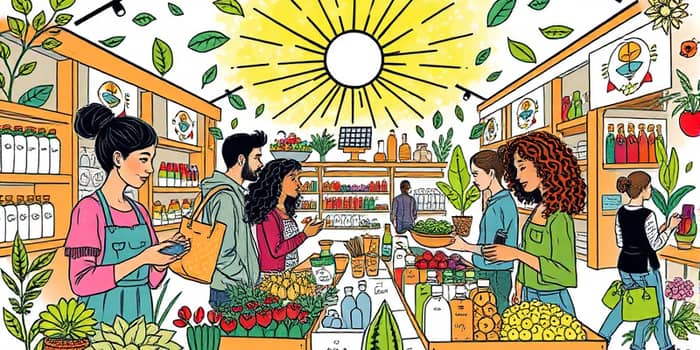
In an era defined by economic pressures and a renewed focus on global challenges, a new archetype has emerged: the conscious consumer. These individuals blend value-conscious shopping with deep purpose, prioritizing not only price and quality but also sustainability, social impact, and transparency. As inflation hovers around 2.7% in 2026 and tariffs reshape global trade, more people are rethinking how and why they spend.
Conscious consumers navigate a complex landscape where trading down in some categories creates freedom to splurge on experiences and values-driven purchases. This article explores the forces shaping modern spending, offers practical guidance, and inspires every reader to align their wallets with their convictions.
Understanding the Economic Landscape
Persistent inflation and tariff impacts have fueled unprecedented price sensitivity: over 60% of shoppers prioritize affordability, and 74% would switch brands for lower regular prices. Yet this keen focus on cost coexists with a refusal to compromise on core values. Consumers of all income levels hunt for deals through private labels, bulk buying, cash-back apps, and off-price retailers, even when disposable income rises.
This fragmented spending across more stores reflects a broader shift: modern buyers trade loyalty for opportunity. They shop three times as many outlets as in previous years, carefully reallocating budgets to the categories that matter most—experiences, wellness, and values-aligned products. Brands must adapt by delivering transparent pricing, consistent quality, and proof of impact to earn lasting trust.
Sustainability as a Non-Negotiable Principle
More than ever, sustainability is non-negotiable. Seventy-two percent of consumers report buying more eco-friendly products than two years ago, and 62% always or often seek out evidence of environmental credentials. This demand has driven Gen X’s willingness to pay a 10% premium to soar from 34% in 2019 to 90% in 2022.
Yet vague green claims no longer suffice. Shoppers demand verifiable sustainability data and proof—from EU digital product passports documenting carbon footprints to material and circularity metrics displayed on packaging. Brands like IKEA, which plans to be climate-positive by 2030, and Patagonia, offering repair services and donating 1% of sales to environmental causes, set new benchmarks for authenticity.
Embracing Social and Community Values
Beyond the planet, conscious consumers care deeply about people and community. Sixty-nine percent prefer socially conscious brands, 60% prioritize diversity and inclusivity, and 68% seek positive online environments. These values shape decisions from grocery aisles to social feeds, driving 63% of shoppers to write reviews primarily to help others.
Wellness and local support interweave with social responsibility. Community-driven markets, cooperatives, and local artisans thrive as people seek connections and meaningful impact. Whether through fair-pay labels, donations to local causes, or supporting minority-owned businesses, conscious consumers use their spending power as a tool for positive change.
Generational Perspectives
Each generation brings unique motivations, though all converge around value plus values. As Gen Z prepares to inherit $68 trillion by 2030, their digital fluency and sustainability convictions will reshape markets. Meanwhile, Millennials remain online shopping champions, and Gen X leads premium sustainability spending.
Practical Steps to Spend with Purpose
- Audit your usual purchases and identify items you can trade down without sacrificing quality.
- Research brand credentials by checking verified sustainability reports and ESG data.
- Support local businesses and community initiatives to strengthen social bonds.
- Set aside a budget for experiences—travel, dining, classes—that enrich your life.
- Use deal-finding tools and loyalty programs to optimize value without undermining your values.
Looking Ahead: The Future of Conscious Consumption
As we move deeper into 2026, conscious consumerism will continue to evolve. Social commerce is poised to capture 17% of online sales, blending the influence of community with seamless shopping. Renewable energy demand in solar and wind sectors will grow over 17%, reinforcing the link between spending and systemic change.
Brands that invest in transparency, leverage data-driven personalization, and collaborate authentically with communities will thrive. For consumers, the journey toward purpose-driven spending is both empowering and unifying, reminding us that every purchase carries potential—potential to protect the planet, uplift communities, and reflect our highest aspirations.
References
- https://www.circana.com/post/unpacking-consumer-marketing-trends-that-will-drive-growth-in-2026
- https://www.inriver.com/resources/do-consumers-care-about-sustainability/
- https://www.netguru.com/blog/consumer-behavior-trends
- https://www.spglobal.com/sustainable1/en/insights/2026-sustainability-trends
- https://www.im.natixis.com/en-sg/insights/equities/2026/the-rise-of-the-value-conscious-consumer
- https://www.youtube.com/watch?v=R-bL5kJgTL4
- https://escalent.co/blog/top-consumer-trends-2026-market-research-insights-brands-need-to-build-winning-strategies/
- https://www.privatebank.bankofamerica.com/articles/2026-consumer-outlook.html
- https://www.upside.com/business/retailer-blog/consumer-spending-trends-2026
- https://www.cbo.gov/publication/62105
- https://www.salsify.com/blog/shopper-spending-changes-in-2026
- https://www.capgemini.com/insights/research-library/what-matters-to-todays-consumer-2026/
- https://theroundup.org/environmentally-conscious-consumer-statistics/