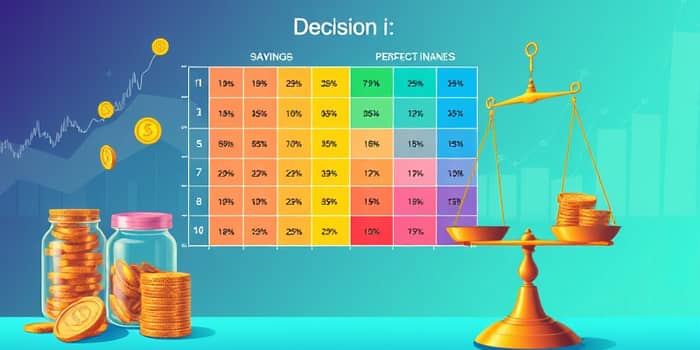
In an age of endless financial choices and constant market noise, making the right money decisions can feel overwhelming. Enter the Money Management Matrix, a structured decision-making framework designed to bring objectivity and clarity to your personal finances. By breaking complex situations into weighted criteria and scoring options methodically, this tool empowers you to choose the best path—free from emotional bias.
Whether you’re allocating your monthly budget, deciding on debt repayment methods, or sizing trading positions, the Money Management Matrix offers data-driven choices in complex scenarios. It doesn’t dictate a single “right” answer; it provides transparency and insight so you can tailor outcomes to your unique goals.
Origins and Fundamentals
The Money Management Matrix builds on the classic decision matrix, which lists options, defines evaluation criteria, assigns weights on a consistent scale, and calculates weighted totals. Traditionally, this tool has guided business and project decisions by quantifying cost, risk, and return. The money management variant adapts these principles to financial planning, budgeting, and investing.
Key steps include:
- Define clear options (e.g., stocks, bonds, real estate)
- Establish criteria such as risk, return, liquidity, and time horizon
- Assign weights (typically on a 1–5 scale) to reflect each criterion’s importance
- Score each option consistently against these criteria
By comparing weighted scores instead of gut feelings, you gain quantifiable insights for confident decisions. Traders use it for position sizing and volatility management, while savers apply it to budget buckets or debt strategies.
Key Benefits and Empowerment
Adopting the Money Management Matrix yields transformative advantages:
- Objectivity and Clarity: Quantifies decisions, reducing bias and uncertainty.
- Efficiency and Customizability: Speeds evaluation and adapts to personal or client needs.
- Accountability and Review: Ensures all factors are considered and invites periodic revisits.
- Strategic Financial Edge: Balances transactional cash, savings, and strategic reserves.
Imagine dividing your emergency fund into buckets—transactional, reserve, and yield-focused strategic cash. The Matrix helps assign each bucket a score based on liquidity needs, interest rates, and safety, leading to an optimized cash structure.
Applications Across Every Financial Journey
The versatility of the Money Management Matrix shines through its broad range of applications:
- Personal budgeting: Allocate income across expenses, savings, and investments.
- Debt reduction: Choose between snowball or avalanche repayment methods.
- Investment selection: Evaluate stocks, funds, or real estate based on your criteria.
- Career decisions: Compare job offers by salary, benefits, growth, and location.
Beyond individual finance, businesses leverage hybrid matrix structures for cross-functional collaboration, while project managers use cost-rate matrices to optimize resources. Traders refine position sizes and exit strategies by scoring volatility, drawdown risk, and profit potential.
Implementing Your Own Money Management Matrix
Creating your personalized Matrix is straightforward. Follow this step-by-step guide to build a tool you’ll trust:
- 1. Define the decision to make (e.g., selecting a mutual fund).
- 2. List your options clearly.
- 3. Choose criteria most relevant to your goals.
- 4. Assign consistent weights (1–5) reflecting importance.
- 5. Score each option objectively on the same scale.
- 6. Calculate weighted totals and compare results.
- 7. Analyze the highest scorer, then adjust weights or scores if needed.
Use spreadsheets like Excel or Google Sheets for automatic calculations. For those who prefer apps, platforms such as Airtable, Smartsheet, and dedicated decision-matrix tools offer templates with built-in features.
Best Practices: Do’s and Don’ts
Avoiding Common Pitfalls
While the Money Management Matrix is powerful, be vigilant about:
1. Criteria creep: Adding too many factors dilutes focus. Stick to what truly drives outcomes.
2. Scale inconsistency: Mixing 1–5 with 1–10 scales can distort results. Standardize your approach.
3. Ignoring intuition entirely: Use the Matrix to inform, not replace, your judgment.
By blending systematic analysis with periodic qualitative review, you strike a balance between numbers and lived experience.
Conclusion: Mastering Your Financial Future
The Money Management Matrix equips you with a framework for objective decision-making that evolves alongside your dreams and market shifts. Whether you’re plotting retirement savings, repaying debt, or sizing trades, this tool transforms guesswork into clarity.
Embrace the Matrix today, and elevate your money choices from reactive to strategic. As you refine weights, criteria, and scores over time, you’ll build an ever-improving compass guiding you toward lasting financial success.
References
- https://www.meegle.com/en_us/topics/decision-matrix/decision-matrix-for-personal-finance
- https://www.financialplanningassociation.org/article/journal/AUG13-decision-matrix-approach-retirement-income-portfolio-design
- https://visionarymind.me/p/the-money-management-matrix-prioritizing-your-pennies/
- https://www.aim.com.au/blog/the-matrix
- http://traders.com/documentation/feedbk_docs/2006/12/Abstracts_new/Nilsson/nilsson.html
- https://www.global-integration.com/insights/matrix-management-in-the-finance-function/
- https://www.morganstanley.com/articles/how-to-manage-cash-strategically
- https://ftpdocs.broadcom.com/cadocs/0/CA%20Clarity%20PPM%2013%203%2000%20%20On%20Demand%20-ENU/Bookshelf_Files/HTML/finmgt/1715405.html
- https://orrinwoodwardblog.com/the-financial-matrix/
- https://www.vantagepointsoftware.com/blog/decoding-the-money-matrix/