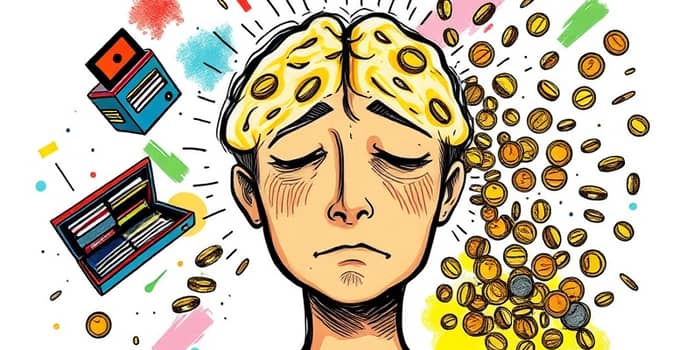
Have you ever felt a sudden urge to buy something just because it's on sale or limited in stock?
This impulse is often driven by scarcity psychology, a mental trap that influences our financial behavior.
Scarcity arises when our wants exceed our resources, leading to frustration and poor decision-making.
It consumes your mental bandwidth, the cognitive capacity needed for planning and problem-solving.
As studies reveal, this affects everyone from struggling families to high-powered professionals.
Understanding this psychology can help you make wiser money choices and avoid common pitfalls.
In this article, we'll explore how scarcity shapes your finances and provide practical strategies to overcome it.
The Cognitive Toll: How Scarcity Drains Your Mind
Scarcity doesn't just affect your wallet; it hijacks your brain.
It leads to tunnel vision, where you focus solely on immediate shortages.
This narrow focus can make you ignore important bills or long-term goals.
Your frontal lobe, responsible for rational decisions, becomes impaired under scarcity.
Key cognitive impacts include:
- Reduced mental bandwidth for planning and self-control.
- Increased forgetfulness and lowered performance in tasks.
- Impaired cognitive function, leading to more errors.
- A tendency to prioritize short-term gains over long-term benefits.
For example, research shows that poverty can temporarily drop IQ scores, similar to how time scarcity affects busy executives.
This cognitive drain explains why people in financial stress often make rash choices.
Emotional Drivers: Fear, Anxiety, and FOMO
Emotions play a huge role in scarcity-driven spending.
Fear of missing out (FOMO) is a powerful trigger for impulse buys.
Scarcity evokes negative feelings like stress, anxiety, and shame.
These emotions can cause avoidance behaviors, such as ignoring financial statements.
- Loss aversion makes people fear losses more than they value gains.
- Anxiety from financial scarcity can lead to emotional overload.
- Shame often prevents engagement with money management.
- Anticipated regret from missing out drives urgent purchases.
Understanding these emotional drivers can help you recognize when scarcity is influencing your decisions.
By acknowledging feelings like FOMO, you can pause and reflect before spending.
Behavioral Effects: Impulse Buying and Hoarding
Scarcity often translates into specific actions that harm your finances.
Impulse buying is a common result, mediated by emotional responses to perceived shortages.
Hoarding and panic buying cycles can waste money on unneeded items.
The bandwagon effect, where others' actions amplify impulsivity, exacerbates this.
- Impulsive purchases driven by scarcity and FOMO.
- Hoarding behaviors triggered by fear of future shortages.
- Deviant actions like in-store hiding of products.
- Increased competitiveness in acquiring scarce resources.
To illustrate, here's a table summarizing key behavioral effects:
This table highlights how scarcity behaviors directly impact your wallet.
Social and Self-Perception: Competition and Inflated Self-View
Scarcity doesn't just affect you individually; it alters how you see yourself and others.
It can lead to an above-average effect, where people under scarcity view themselves more positively.
This temporary boost in self-esteem might hinder long-term coping strategies.
Scarcity often makes people see others as rivals for limited resources.
- Reduced cooperation and increased competitiveness in social settings.
- Stunted personal growth due to focus on immediate needs.
- Inferences of lower status from financial scarcity, leading to more negative emotions.
- A mindset that prioritizes survival over collaboration or self-improvement.
These social effects can isolate you and prevent seeking help for financial issues.
Recognizing this can encourage more empathetic interactions and support networks.
Money-Specific Impacts: Poor Trade-Offs and Financial Mistakes
When it comes to money, scarcity has unique consequences that demand attention.
People often make poor trade-offs, such as undervaluing time for minimal savings.
This is evident in how low-income consumers might spend hours to save a few dollars.
Scarcity can also lead to delayed gratification issues, making it hard to save for the future.
- Mismanagement of resources similar to dieters or executives under time pressure.
- Increased likelihood of avoiding financial tools or advice due to shame.
- Tendency to choose immediate financial relief over long-term stability.
- Vulnerability to marketing tactics that exploit scarcity perceptions.
For instance, retailers use limited stock to boost sales, playing on your fear of missing out.
By being aware, you can resist these tactics and make more rational spending choices.
Overcoming Scarcity: Practical Strategies for Financial Control
Breaking free from scarcity psychology is possible with mindful strategies.
Start by increasing awareness of how scarcity affects your thoughts and emotions.
Implement low-load strategies to reduce cognitive burden in financial decisions.
For example, automate savings and bill payments to minimize mental effort.
- Practice mindfulness to recognize and pause during impulse urges.
- Set clear financial goals to counteract tunnel vision.
- Use budgeting tools to simplify money management and reduce stress.
- Seek social support to combat isolation and gain perspective.
- Educate yourself on marketing tactics to avoid scarcity traps.
Research suggests that reducing cognitive load through empathetic communication can help.
By applying these tips, you can reclaim your mental bandwidth and make better financial choices.
Remember, scarcity is a mindset that can be shifted with consistent effort.
Embrace abundance thinking by focusing on what you have and planning for growth.
This journey towards financial freedom starts with understanding the psychology behind your decisions.
References
- https://en.wikipedia.org/wiki/Scarcity_(social_psychology)
- https://www.frontiersin.org/journals/psychology/articles/10.3389/fpsyg.2022.792419/full
- https://www.webmd.com/mental-health/what-is-scarcity-mentality
- https://www.journals.uchicago.edu/doi/full/10.1086/710531
- https://pmc.ncbi.nlm.nih.gov/articles/PMC10604485/
- https://pmc.ncbi.nlm.nih.gov/articles/PMC10242224/
- https://www.apa.org/monitor/2014/02/scarcity
- https://uniathena.com/psychology-of-scarcity-fomo-buying-behavior
- https://www.youtube.com/watch?v=oMqZg2TrAqA
- https://digitalcommons.unl.edu/cgi/viewcontent.cgi?article=1045&context=businessdiss
- https://www.convertize.com/glossary/scarcity-effect/
- https://www.symend.com/blog/how-scarcity-can-inhibit-decision-making-and-customer-engagement
- https://www.deloitte.com/us/en/insights/topics/leadership/scarcity-mind-set-improving-decision-making.html
- https://www.hks.harvard.edu/centers/cid/publications/books/scarcity-why-having-too-little-means-so-much