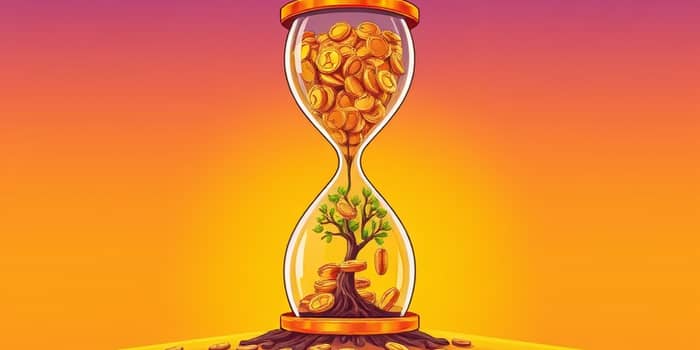
Imagine holding a dollar in your hand today. It feels tangible, ready to be spent or invested.
Now, picture that same dollar a year from now. It might seem identical, but in the world of finance, it’s fundamentally different.
This is the core of the time value of money, a principle that can transform how you view your finances.
At its heart, this concept tells us that money available now is worth more than the same amount in the future.
Why? Because today’s money has the potential to earn returns through investment or interest.
Over time, this can lead to significant growth, shaping everything from personal savings to global economies.
By grasping this idea, you gain a powerful tool for planning your financial journey.
It’s not just about numbers; it’s about making choices that align with your goals and dreams.
Let’s dive into why this matters and how you can apply it to build a secure, prosperous life.
The Power of Today’s Money
Money today is more valuable due to its earning potential.
When you invest or save, your funds can generate interest or returns.
This creates a compounding effect where earnings build upon themselves over time.
Additionally, inflation gradually reduces the purchasing power of future money.
There’s also the risk that future payments might not materialize as expected.
Understanding these factors helps you appreciate why immediate financial opportunities are so crucial.
Here are the key reasons why money today outweighs its future equivalent:
- Earning potential via interest or investment returns.
- The compounding effect, which accelerates growth.
- Time preference for immediate use or security.
- Inflation eroding future value.
- Reduced risk of non-receipt or uncertainty.
By recognizing this, you can prioritize actions that maximize your current resources.
Why Tomorrow’s Dollar is Worth Less
Future money faces challenges that diminish its worth.
Opportunity cost is a major factor; if you don’t invest today, you miss out on potential gains.
For example, $1,000 kept idle loses $50 in a year at a 5% return rate.
This loss isn’t just theoretical—it impacts your long-term wealth accumulation.
Moreover, economic fluctuations can affect how much your money can buy later.
Embracing this reality encourages proactive financial management.
It’s about seeing money as a dynamic asset that grows with time and care.
Calculating Your Future Wealth
To harness the time value of money, you need to calculate future worth.
Future value (FV) projects the value of a present sum forward in time.
The primary formula for compounded growth is essential here.
It uses present value, interest rate, and time periods to estimate outcomes.
This mathematical approach turns abstract concepts into actionable insights.
Here are the basic formulas for future value calculations:
- For compounded growth: FV = PV × (1 + r)^n
- For simple interest: FV = PV × [1 + (r × t)]
- For continuous compounding: FV = PV × e^(r × t)
Adjust these for different compounding frequencies, like monthly or annually.
Excel functions, such as =FV(rate, nper, pmt, pv), simplify this process.
Mastering these tools empowers you to plan with confidence and precision.
Real-World Examples to Illustrate
Let’s explore practical scenarios to make this concept tangible.
These examples show how small changes in rate or time can lead to big differences.
They highlight the importance of starting early and choosing the right strategies.
Consider this list of numerical examples to see future worth in action:
- $1,000 at 10% for 1 year grows to $1,100 with compounding.
- The same $1,000 at 5% for 2 years becomes $1,102.50.
- With semi-annual compounding, $100 at 10% for 1 year yields $110.25.
- Simple interest on $1,200 at 10% for 6 years results in $1,920.
- Monthly compounding with additional payments can boost growth further.
Each case underscores how consistent investment and compounding drive wealth.
Use these as benchmarks to evaluate your own financial plans and goals.
Beyond Basics: Applications in Finance
The time value of money extends beyond simple savings.
It’s foundational for present value calculations, used in net present value (NPV) analysis.
This helps in assessing investments, bonds, and annuities effectively.
In personal finance, it guides retirement planning and loan comparisons.
Businesses apply it to project future benefits and costs for decision-making.
Engineering and economic analyses use factors to convert cash flows.
Here’s a table summarizing key cash flow conversion factors:
Sum these converted values to determine total future worth in complex scenarios.
Understanding this broadens your financial toolkit for various life stages.
Tools and Strategies for Mastery
To apply these concepts, leverage available tools and resources.
Timelines visually map cash flows, making them easier to analyze.
Tables and factors streamline calculations for repeated use.
Digital tools like Excel or financial calculators automate complex math.
They reduce errors and save time, allowing for more strategic planning.
Consider these practical strategies to integrate time value into your life:
- Start investing early to maximize compounding effects.
- Regularly review and adjust your savings for inflation.
- Use present value to compare future payment options.
- Apply future worth calculations to set realistic financial goals.
- Educate yourself on varying rates and advanced models for deeper insights.
By adopting these approaches, you turn theoretical knowledge into real-world financial empowerment.
Embrace the journey of learning and growth, as each step brings you closer to security.
Navigating Risks and Considerations
While the time value of money offers opportunities, it’s not without risks.
Inflation can outpace returns, diminishing future purchasing power.
Higher discount rates in uncertain times lower the present value of future sums.
Market volatility affects investment outcomes, requiring diversified strategies.
Awareness of these factors helps you make balanced, informed decisions.
It’s about managing expectations and preparing for various economic conditions.
This proactive mindset ensures that your financial plans remain resilient and adaptive.
Ultimately, the time value of money is a lens through which to view all financial choices.
It encourages foresight, discipline, and a commitment to long-term well-being.
By mastering its principles, you unlock the door to a future filled with possibilities and peace of mind.
References
- https://batdacademy.com/en/post/understanding-the-time-value-of-money-key-concepts-and-applications
- https://prepineer.com/problems/future-worth-analysis/
- https://www.accountingcoach.com/blog/what-is-the-time-value-of-money
- https://corporatefinanceinstitute.com/resources/valuation/future-value-formula/
- https://www.businessinsider.com/personal-finance/investing/time-value-of-money
- https://www.wallstreetprep.com/knowledge/future-value-fv/
- https://en.wikipedia.org/wiki/Time_value_of_money
- https://bungalow.com/articles/what-is-future-value
- https://corporatefinanceinstitute.com/resources/valuation/time-value-of-money/
- https://www.rocketmoney.com/learn/investing/future-value
- https://www.khanacademy.org/economics-finance-domain/core-finance/interest-tutorial/present-value/v/time-value-of-money
- https://www.adventuresincre.com/glossary/future-value-factor/
- https://www.youtube.com/watch?v=bYLQx5-JPWc
- https://equitymultiple.com/blog/future-value-how-to-project-your-investments-growth
- https://www.accountingcoach.com/future-value-of-a-single-amount/explanation