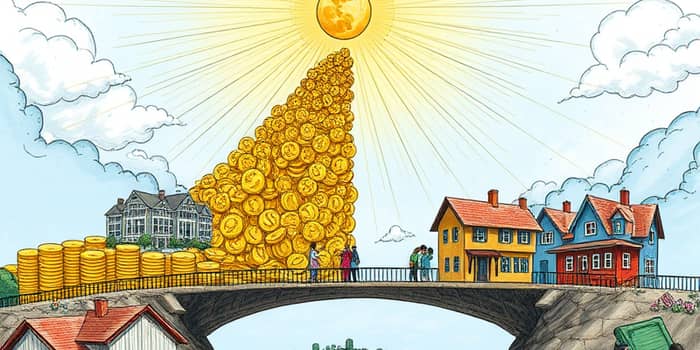
We stand at a pivotal moment in history, witnessing both unprecedented prosperity and staggering inequality. Global wealth distribution has skewed to extremes, leaving billions at a disadvantage and concentrating fortunes in the hands of a few. Understanding the forces behind this gap and the levers for change empowers us to build a more inclusive future.
Scale and Scope of Global Inequality
The numbers are startling. Today, the top 0.001% owns three times the wealth of the bottom half of humanity combined. Within nearly every region, the top 1% hold more wealth than the bottom 90%.
- Bottom 50% of adults: 2.8 billion people
- Middle 40% of adults: 2.2 billion people
- Top 10% of adults: 556 million people, including 56 million in the top 1%
Such disparity not only undermines social cohesion but also hinders the potential of communities around the world.
Wealth vs Income: A Crucial Distinction
Income inequality garners headlines, but wealth gaps are often far wider. Wealth includes assets, investments, and property—creating intergenerational advantages that income alone cannot capture.
Regions with the greatest divides include North America and Oceania, where the ratio of wealth to income exceeds 520 to 1. In Sub-Saharan Africa, high income gaps combine with wealth disparities over 260 to 1. Even Europe, with lower income inequality, shows a nearly 200 to 1 ratio for the top 10% versus the bottom 50%.
This comparison underscores why tackling wealth inequality demands distinct strategies from those aimed solely at income.
Systemic Drivers of the Wealth Gap
At the heart of these divides lie structural forces. The global financial system favors wealthy nations, diverting roughly 1% of world GDP annually from poorer to richer economies through imbalanced interest payments and yields.
Historical disinvestment, discriminatory policies, and unequal access to quality education have entrenched advantages. Areas with underfunded schools, limited healthcare, and scarce credit access see families trapped in cycles of poverty.
Moreover, globalization’s paradox widens domestic gaps: while cross-border inequality falls, within-country disparities soar as capital and skilled workers capture the lion’s share of gains.
Solutions: Policies for a Fairer Future
Addressing the wealth gap requires comprehensive policy cocktails—coordinated reforms that tackle taxes, labor markets, education, and financial access simultaneously.
- Progressive Taxation: Close loopholes, raise capital income taxes, and ensure the ultra-wealthy contribute their fair share.
- Asset-Building Programs: Implement “Baby Bonds,” auto-enroll workers in retirement plans with matching contributions, and expand homeownership support.
- Education Investments: Universal Pre-K, fully funded Pell Grants, apprenticeships, and tuition-free public college open doors to higher earnings.
- Worker Protections: Raise the minimum wage, strengthen overtime rules, expand earned sick leave, and regularize undocumented laborers.
- Healthcare & Nutrition: Expand Medicaid, implement Medicare for All, and increase food assistance to reduce financial burdens on families.
Community and Structural Change
Policy alone cannot succeed without grassroots leadership and inclusive decision-making. Communities most impacted by inequality must co-create solutions, ensuring reforms align with real needs.
Structural change also means reforming international frameworks: fair trade rules, debt relief for developing countries, and equitable financial regulations that stop capital flight and tax avoidance.
Charting a Path Forward
The gap between the wealthiest and the rest is not an inevitable outcome but a choice shaped by policy and power. We can choose equity over exclusion, collective wellbeing over concentrated gain.
As individuals, we can support initiatives that expand access to quality education, back organizations fighting for tax justice, and elect leaders committed to transformative change. Together, we can build an economic landscape where opportunity is within reach for all, not just the privileged few.
By understanding the roots of wealth disparities and championing bold, interconnected reforms, we lay the groundwork for a future where prosperity lifts every community, not just the elite. The time for action is now—let’s bridge the gap, reshape our institutions, and secure a more just world for generations to come.
References
- https://wir2026.wid.world/insight/global-economic-inequity/
- https://policiesforaction.org/node/818
- https://wid.world/news-article/world-inequality-report-2026-inequality-persist-at-a-very-extreme-level/
- https://belonging.berkeley.edu/six-policies-reduce-economic-inequality
- https://worldpopulationreview.com/country-rankings/wealth-inequality-by-country
- https://www.clasp.org/press-room/news-clips/10-solutions-fight-economic-inequality/
- https://www.oxfam.org/en/press-releases/billionaire-wealth-jumps-three-times-faster-2025-highest-peak-ever-sparking
- https://inequality.org/article/ten-solutions-bridge-racial-wealth-divide/
- https://www.ituc-csi.org/world-economic-forum-2026
- https://siepr.stanford.edu/publications/policy-brief/policy-cocktails-attacking-roots-persistent-inequality
- https://www.oxfamamerica.org/explore/issues/economic-justice/extreme-inequality-and-poverty/
- https://nonprofitquarterly.org/from-precarity-to-promise-how-public-policy-can-reverse-the-wealth-gap/
- https://socialcapitalpartners.ca/what-the-new-world-inequality-report-tells-us-and-why-it-matters-for-canada/
- https://www.hks.harvard.edu/centers/mrcbg/programs/growthpolicy/racial-wealth-inequality-social-problems-and-solutions
- https://democrats-financialservices.house.gov/issues/narrowing-the-wealth-gap.htm